Choose the correct letter, A, B or C.
21 Why did Chloe and Marcus choose Lumina Portraits as their case study?
A. Marcus’s uncle is a close friend of the studio owner.
B. The business suffers severe financial losses from absent clients.
C. The studio specifically requested their academic assistance.
22 What surprising finding did Marcus discover in his preliminary research?
A. Weekends have the highest rates of client absence.
B. Corporate bookings are frequently rescheduled.
C. Sending reminders too early increases the no-show rate.
23 What does Chloe consider to be the biggest flaw in the studio’s current policy?
A. It relies entirely on passive communication.
B. The penalty fee charged is far too low.
C. The policy document is overly complicated to read.
24 Who will the students interview next Tuesday to understand the impact of the issue?
A. The lead photographer
B. Former clients who missed appointments
C. The reception staff
Questions 25 to 30
Complete the flow-chart below.
Write ONE WORD ONLY for each answer.
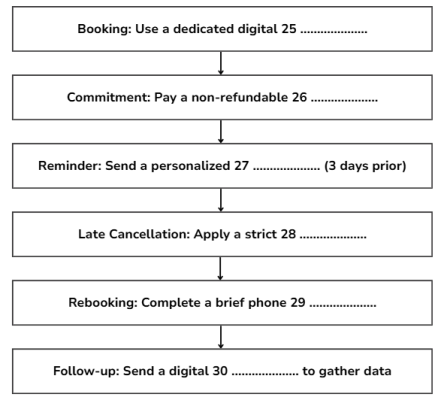
Proposed No-Show Prevention Strategy
Keys
21 B
22 C
23 A
24 C
25 portal
26 retainer
27 video
28 penalty
29 interview
30 questionnaire
Transcripts
Part 3: You will hear two business students, Chloe and Marcus, discussing a project on creating a no-show policy for a photography studio.
MARCUS: Hi Chloe, let’s nail down this no-show policy project for Professor Aristhorne. Are we ready to finalize the details today? I want to make sure our presentation is completely ready by Friday.
CHLOE: Sounds good to me. I am really glad we pivoted away from the restaurant industry and settled on Lumina Portraits for our case study instead. I know your uncle is a close friend of the studio owner, which helps a lot.
MARCUS: He is, but that is actually just a coincidence. The real reason I pushed for them is that the studio suffers massive financial losses whenever clients fail to appear. They book out the entire space and hire staff.
CHLOE: Right. Fixing that revenue drain is a much stronger academic angle for our final paper.
MARCUS: Exactly. Speaking of which, I was looking at industry data yesterday to understand consumer psychology. I fully expected weekends to have the highest absence rates.
CHLOE: Or maybe corporate bookings, since those get rescheduled constantly due to meetings?
MARCUS: Actually, neither. The most surprising finding was that if reminders are sent out too early, say a month in advance, no-shows dramatically increase. People just forget.
CHLOE: Wow, that is counter-intuitive. Looking at Lumina’s current setup, they charge a steep seventy-five pounds for a missed session.
MARCUS: So why doesn’t it work? Is it because the policy document is overly complicated to read?
CHLOE: No, the wording is perfectly clear. The real flaw is that it relies entirely on passive communication. They just have the rules listed on their website and hope people see it.
MARCUS: That definitely needs changing. Are we meeting the lead photographer next Tuesday to discuss this issue?
CHLOE: Unfortunately, the photographer is shooting a wedding out of town. Instead, I secured a meeting with the reception staff. They are the ones answering angry phone calls when someone fails to arrive.
MARCUS: Perfect. Let’s move on to our proposed strategy flowchart. Step one of our new policy involves the initial booking phase. Right now, they take reservations over the phone.
CHLOE: We need to transition them to a digital platform. A dedicated portal handles everything automatically and forces clients to actively click an agree button on the terms.
MARCUS: Got it. At step two, we must secure true commitment. We must require a non-refundable retainer to lock in the time slot.
CHLOE: I completely agree. No money down means no commitment from the client.
MARCUS: For step three, the reminder phase. We know early reminders fail. So, exactly three days prior to the shoot, we send a short, personalized video from the photographer.
CHLOE: A video is brilliant! It builds a personal connection.
MARCUS: Exactly. Now, step four deals with late cancellations within forty-eight hours. What happens then?
CHLOE: We implement a strict penalty. We automatically charge the remaining balance to their registered card.
MARCUS: Very practical for long-term revenue. Step five is for those who do cancel but want to rebook later.
CHLOE: They must complete a brief phone interview with the manager. It establishes boundaries and ensures they are serious this time.
MARCUS: Good strategy. Finally, step six is post-service. We need data to see if the new policy improves client satisfaction.
CHLOE: We could offer a discount voucher for their next visit?
MARCUS: No need to lose future profits. Just send them a quick digital questionnaire immediately after they leave the studio.