21 What surprised Julia most about the recent consumer survey on cultured meat?
A the willingness of older people to try it
B the main reason people hesitate to buy it
C the confusion over its nutritional value
22 Professor Vance suggests that Julia should focus her literature review on
A public marketing campaigns.
B ethical arguments for production.
C scaling up manufacturing.
23 When discussing the Valerius Project, they agree that it failed because of
A poor advertising.
B high equipment costs.
C restrictive government policies.
24 What is Julia’s immediate next step for her assignment?
A designing a questionnaire
B reviewing the laboratory timetable
C interviewing a bio-engineer
Questions 25 to 30
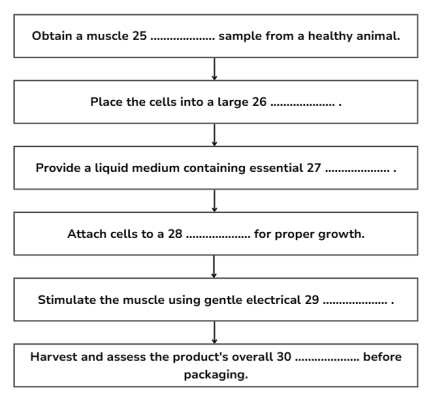
Complete the flow-chart below.
Write ONE WORD ONLY for each answer.
Producing Cultured Meat in the Laboratory
Keys
21 B
22 C
23 B
24 B
25 tissue
26 tank
27 vitamins
28 scaffold
29 pulses
30 flavour / flavor
Transcripts
Part 3: You will hear a student named Julia discussing her research proposal on lab-grown meat with her professor.
PROFESSOR: Ah, Julia, come in. Let’s discuss your proposal for the lab-grown meat research project.
JULIA: Yes, Professor. I actually started by reviewing that recent consumer survey from the Hemlock Institute.
PROFESSOR: Right. Did anything stand out? I know many older demographic groups are suddenly willing to try cultured meat.
JULIA: I expected that trend, to be honest. But what really caught me off guard was why people hesitate to buy it. I assumed everyone worried about the high retail price, but the survey showed concerns about the texture were actually the biggest barrier.
PROFESSOR: True, replicating a steak’s chewiness is tricky. People seem fine with the nutritional value now, though. What about your literature review?
JULIA: I thought of analyzing public marketing campaigns for alternative proteins.
PROFESSOR: That’s been done a lot recently. What if you look into the engineering side? Specifically, scaling up manufacturing. That’s the real challenge, moving from a small bench to a massive factory. The ethical arguments are well-documented, so skip those.
JULIA: Okay, focusing on large-scale production makes sense. I’ll use the Valerius Project as a case study.
PROFESSOR: Good idea. It’s a perfect example of what can go wrong.
JULIA: They faced such restrictive government policies there, right?
PROFESSOR: Actually, local authorities were surprisingly supportive. And it wasn’t poor advertising either; they had a great brand image. The real downfall was the high equipment costs. They just couldn’t afford the specialized machinery to expand.
JULIA: I’ll note that financial aspect. So, what should I do right now? Start designing a questionnaire for the focus group?
PROFESSOR: Hold off on the questionnaire for now. And we can arrange your interview with a bio-engineer later. Your immediate priority is reviewing the laboratory timetable. Secure your bench time before chemistry students take all the available slots.
JULIA: Good point. I’ll book my hours right after this meeting.
PROFESSOR: Excellent. Now, let’s map out the flow-chart for producing cultured meat.
JULIA: The first step is taking a tiny sample of muscle tissue from a healthy animal, usually a cow or a sheep.
PROFESSOR: Correct. And no harm comes to the animal. Then, the stem cells need multiplying.
JULIA: I’ve seen the equipment for this in the laboratory. We place them into a large tank, right?
PROFESSOR: That’s right. Inside, the cells need food. We use a specialized liquid medium.
JULIA: Does it contain amino acids?
PROFESSOR: It does, but primarily, the mixture must be rich in essential vitamins to encourage rapid cellular division.
JULIA: Got it. After they multiply, they need to form actual muscle fibres, otherwise they just turn into a soft paste.
PROFESSOR: Exactly. So we have to attach the cells to a supportive structure.
JULIA: It’s known as a scaffold, right? Often made from edible plant-based materials.
PROFESSOR: Yes, a scaffold provides the necessary three-dimensional framework. But the muscle also needs exercise.
JULIA: How do you exercise cells in a dish?
PROFESSOR: By mimicking natural nerve signals. We stimulate the growing muscle using gentle electrical pulses. This makes the fibres contract and bulk up.
JULIA: Fascinating. Like a tiny workout. Finally, after a few weeks, we harvest the final product.
PROFESSOR: And before packaging it for the supermarket, we run quality control.
JULIA: I suppose we check the colour?
PROFESSOR: Colour is secondary. The most crucial test is to assess its overall flavour. If it doesn’t taste authentic, consumers will simply reject it, regardless of looks.
JULIA: Perfect. I’ll update my flow-chart with these steps. Thanks, Professor.