11 What was the main aim of the cycle lane development?
A to improve access for cyclists travelling into town B to increase the number of visitors to the area C to provide more parking facilities
12 Why was the meadow left undeveloped?
A to reduce construction costs B to encourage wildlife C to allow space for future expansion
13 What is the purpose of the new footbridge?
A to replace an older bridge B to provide a safer river crossing C to create a scenic viewpoint
14 The garden area is mainly intended for
A organised public events B children’s activities C quiet relaxation
Questions 15–20
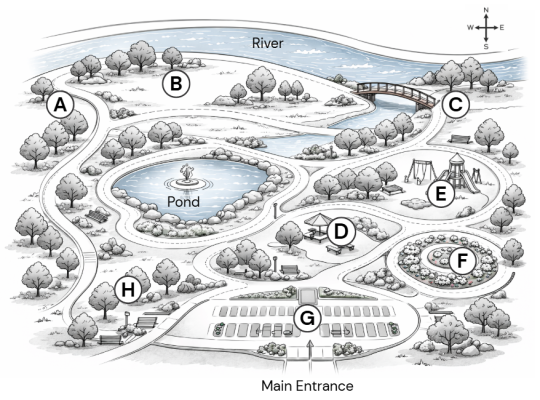
Label the map below. Write the correct letter, A–H, next to Questions 15–20.
15 car park
16 information board
17 bicycle rental station
18 meadow
19 new footbridge
20 seating area
Keys
11 A 12 B 13 B 14 C 15 G 16 H 17 A 18 B 19 C 20 D
Transcript
Part 2: You will hear a talk about a new cycle lane development in a public park.
WOMAN: Good morning everyone, and welcome to Riverside Park. Before you begin your walk, we have invited park officer Samir Patel to explain the recent changes and then talk you through the map. Over to you, Samir.
SAMIR: Thanks, and hello. I will start with the cycle lane development. Some people said the whole project was really about bringing in more visitors, and others believed it was mainly a way to create extra parking. In fact, the aim was to improve access for cyclists travelling into town, particularly at commuting times, by giving them a continuous route that stays inside the park boundary.
Next, I want to mention the meadow beside the river. It was not left undeveloped simply to reduce construction costs, and it is not being kept empty for future building plans. The reason for keeping the meadow as it is was to encourage wildlife. Since it has been protected, we have noticed far more butterflies and bees in summer, and more birds feeding there early in the morning.
You will also see a new footbridge across the water. Some residents assumed it was a replacement for an older crossing further upstream, while others imagined it would be mainly for taking photographs. The real purpose is safety. The bridge is wider, has handrails on both sides, and it keeps walkers away from the traffic on the road bridge nearby.
Finally, there is the garden area. It is not designed for organised public events, and it is not intended for children’s activities. It is mainly meant for quiet relaxation, with low planting, a circular path, and seats set back from the busiest route.
Now let me guide you around the map. If you come in from the main entrance at the bottom, the car park is directly in front of you. It is the only large paved area, and there is a ticket machine in the middle.
Just to the left of the entrance, near the path that curves uphill, you will find the information board. That is where park notices and trail updates are posted.
From there, follow the left hand path as it climbs towards the river. Before you reach the water, you will pass the bicycle rental station beside the path, under the trees.
If you keep going, the path runs along the river edge and opens out into the meadow, which stretches across the northern part of the park.
On the far right of that riverside section, you will see the new footbridge crossing the narrow channel and linking the path to the east side.
Now return towards the centre. The seating area is close to the pond, just south of it, with picnic tables and benches grouped together.
If you have questions, staff are usually near the information board in the morning. Enjoy your visit, please keep to the paths, and do not feed the wildlife. There are drinking fountains near the central path, and bins at each junction, so the park stays tidy.