Part 3: Research on Study Habits
Questions 21–24
Choose the correct letter, A, B or C.
Topic: Research on study habits
21 Emma says many students lose focus mainly because
A they switch tasks too often
B they feel physically uncomfortable
C they try to work for too long without rest
22 What do both students agree about productivity apps?
A They help only in the short term
B They can distract users
C They improve time management
23 James refers to an online survey which
A received dishonest answers
B involved too few participants
C produced inconsistent results
24 In their previous project, they were criticised for
A not showing clearly how their data supported their conclusions
B failing to meet deadlines
C collecting too little data
Questions 25–30
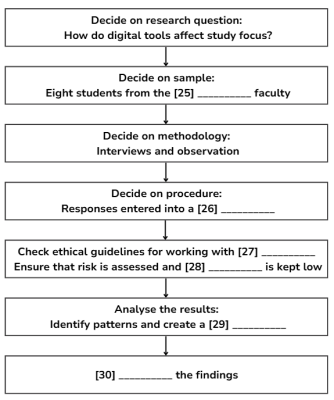
Complete the flow chart below.
Write ONE WORD ONLY for each answer.
Transcripts
Part 3: You will hear two students discussing how to design a small research project for a university assignment.
Emma: Hi James, do you have a moment? I just looked at the course site and the deadline is coming up. We need to lock in our research project.
James: I know. I’ve been hesitating because I can’t decide on an approach that’s interesting but still practical. The tutor keeps saying it has to be something we can study without huge resources.
Emma: True. I’ve been reading psychology blogs and study-skills articles, and they all mention the same problem: students often lose focus because they try to work for too long without stopping. Their attention gets overloaded.
James: That explains my habits. I try to finish everything in one sitting, and after about an hour I’m just staring at the screen, rereading lines, and not processing anything.
Emma: Same. So I think our topic should be study habits, not just motivation. Habits are easier to observe. What if we investigate how digital tools affect concentration?
James: Like apps that block notifications, limit social media, or organise study time?
Emma: Exactly. People recommend them constantly, but I’m not convinced they always help. Sometimes I check the app so often that it becomes another distraction.
James: I agree. I saw an online survey on this, and the answers were inconsistent. Some users said their focus improved; others said they felt more distracted. There wasn’t a clear pattern.
Emma: Which means it’s a useful area to explore. But instead of only asking what people believe, we could observe what they do during a real study session.
James: Observation plus a short interview would be strong. We can ask about their usual routine, then watch how they study for a set time, and note interruptions.
Emma: Also, we should learn from our last project. We were criticised because our conclusions weren’t well supported. We didn’t explain clearly how the data connected to our ideas.
James: Right. This time we need to show the link: results first, interpretation second, and no vague claims.
Emma: So let’s define the research question: how do digital tools affect students’ ability to focus while studying?
James: Good. Now we need a sample that’s easy to access. If we pick random students, scheduling will be a nightmare.
Emma: What about the business faculty? They tend to use productivity apps a lot, and we can recruit from the building where we have classes.
James: Works for me. How many participants?
Emma: Eight students. It’s small enough to manage, but still gives us a range of behaviours.
James: Methodology: mixed methods. Maybe a brief interview before, observation for thirty minutes, and a quick follow-up question after.
Emma: During observation we should use the same checklist for everyone: which app they use, how often they switch tasks, how many times they touch their phone, and any obvious breaks in attention.
James: And we’ll record everything in a spreadsheet so it’s easy to compare and calculate totals. If we time interruptions, we might be able to build simple averages.
Emma: Now ethics. Because we’re working with people, we need informed consent. They must know what we’re recording, that they can stop at any time, and that there’s no penalty for leaving.
James: We should keep stress low too. The activity shouldn’t feel like a test. We can let them choose a normal task, like reading notes or writing an outline.
Emma: And confidentiality matters. Use participant codes, not names, and don’t record private content if a notification appears.
James: After collecting the data, we’ll look for patterns and create a chart to show trends, like whether app users have fewer interruptions.
Emma: Then we’ll evaluate the findings, discuss limitations, and suggest improvements for future research.
James: Great. Let’s organise the interviews tomorrow.
Emma: Agreed. This feels much clearer now.